krkn-dashboard is deprecated and will be archived. If you are looking for a UI to interact with krkn, please migrate to krkn-operator.
Krkn Dashboard is the visualization and control component of krkn-hub. It provides a user-friendly web interface to run chaos experiments, watch runs in real time, and—when configured—inspect historical runs and metrics via Elasticsearch and Grafana. Instead of using the CLI or editing config files, you can trigger and monitor Krkn scenarios from your browser.
What is Krkn Dashboard?
Krkn Dashboard is a web application that sits on top of krkn-hub. The dashboard offers:
A graphical UI for visualizing runs
Select scenarios, set parameters, and start runs from the browser, no command line required. Ideal for demos and anyone who prefers an interactive interface.
Real-time visibility
See running chaos containers and stream logs as scenarios execute. Spot failures and deficiencies as they happen to locate and fix issues faster.
Saved configurations
Store and reuse scenario parameters in your browser. Recreate a test or standardize runs across your team without re-entering the same values.
Analyzing past runs
Connect to Elasticsearch to query and display past run details. Use Grafana to link to dashboards for a specific run.
Central space for collaboration
One place to view runs, share configurations, and collaborate with your team. See status, logs, and history in a single UI instead of scattered terminals or configs.
Features
Run chaos scenarios from the UI
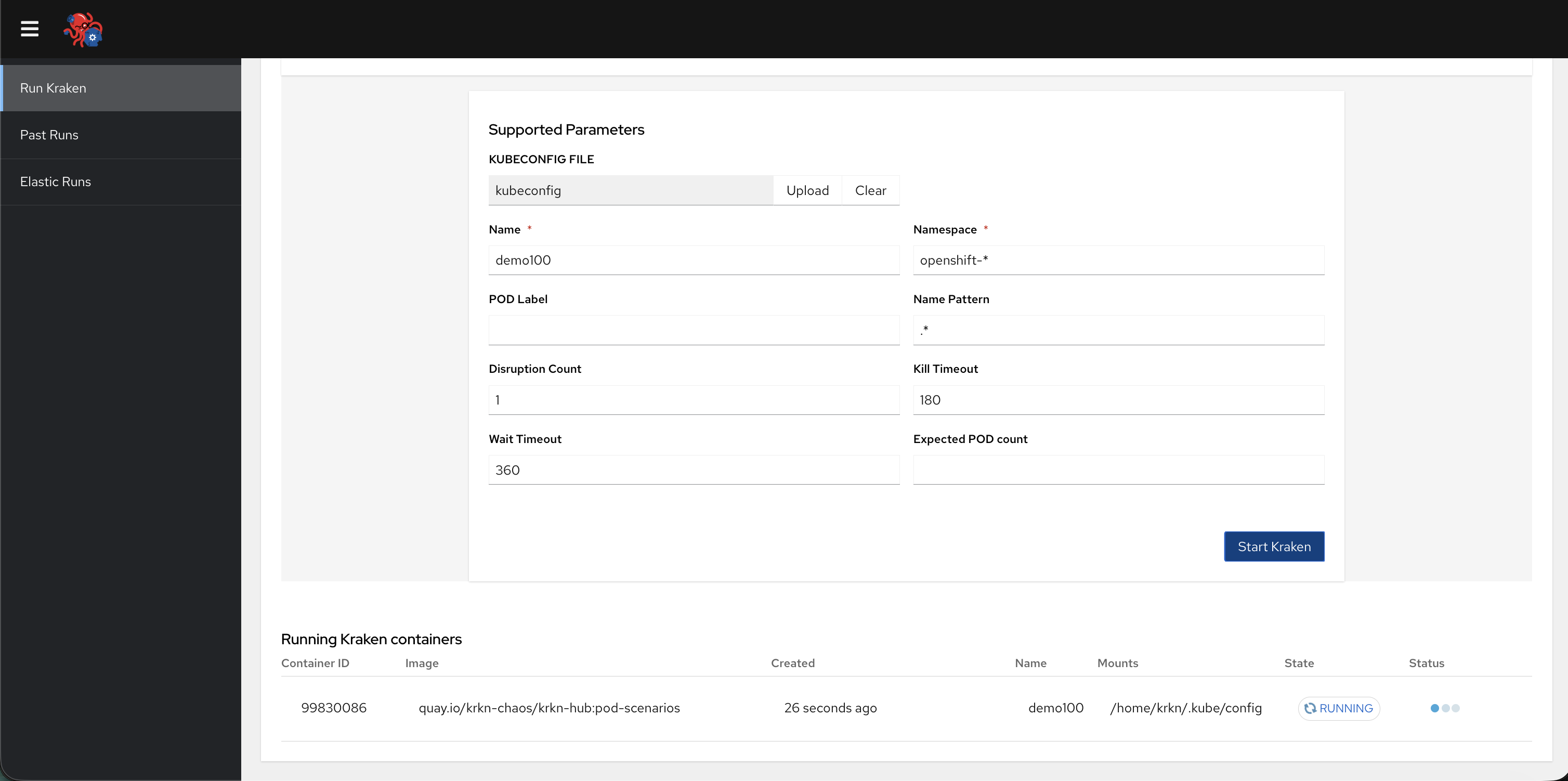
You can run chaos scenarios from the Run Kraken page by choosing a scenario tile and filling in the form:
Choose a scenario — e.g. pod-scenarios, container-scenarios, node-cpu-hog, node-io-hog, node-memory-hog, pvc-scenarios, node-scenarios, time-scenarios.
Set parameters — Namespace, selectors, disruption counts, durations, and other scenario-specific options (the fields map to the environment variables used by krkn-hub).
Provide cluster access — Choose a group and upload or select a kubeconfig the group is allowed to use (see Users and access).
Start the run — The dashboard starts the corresponding krkn-hub container (via Podman/Docker). The Running Kraken containers table lists containers that are still running. When a run finishes, you can open Past Runs to see stored logs, outcomes, and replay options.
Save and Replay Runs
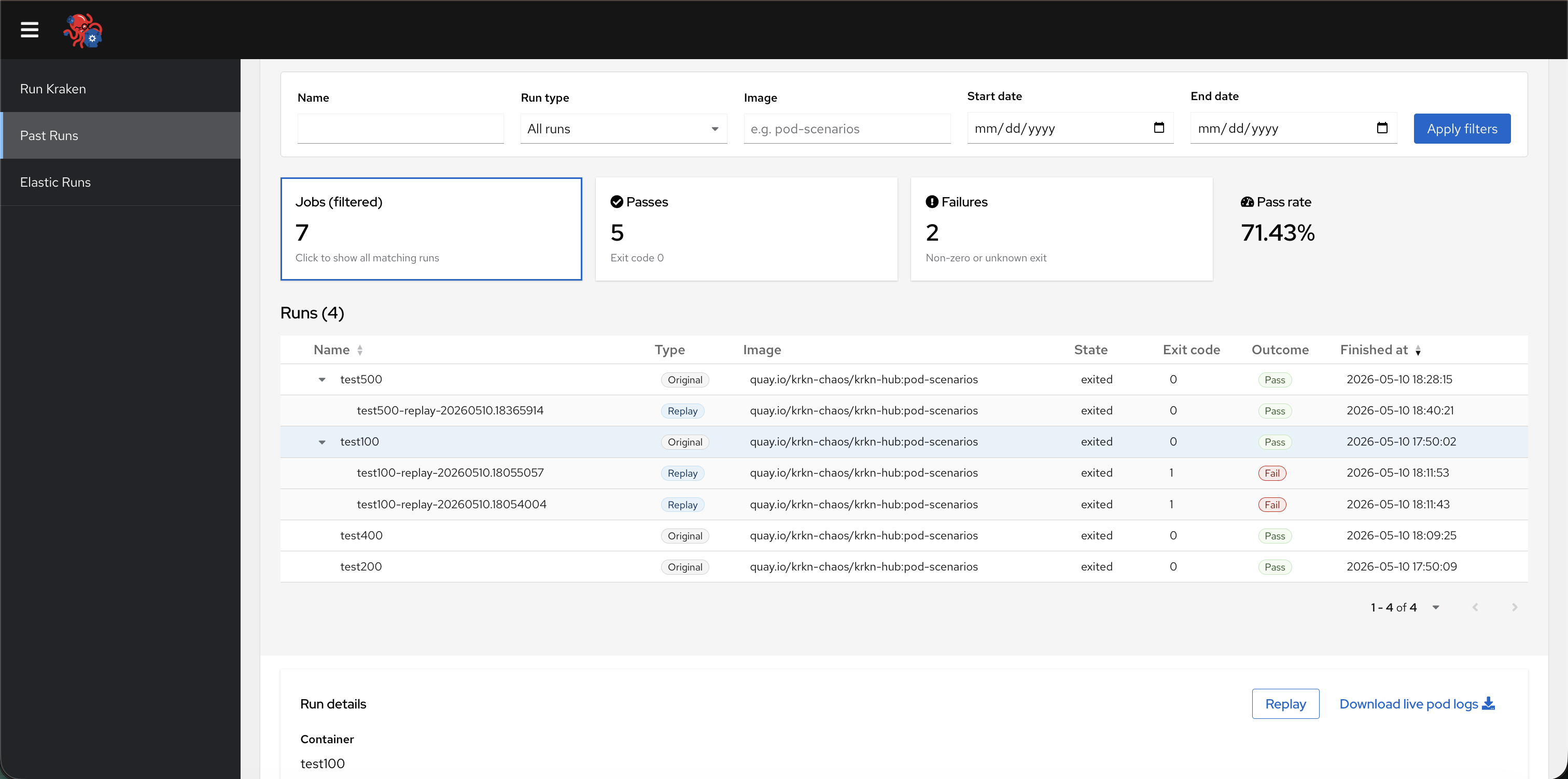
The Past Runs page lists chaos jobs that have completed on the machine where the dashboard server runs. You only see runs for groups you belong to. Selecting a run shows metadata and captured logs.
You can save the current scenario and parameters and load them later. From Past Runs, you can open a finished job and use the Replay button to send the same scenario settings back to Run Kraken, adjust them if needed, and run the experiment again. Replaying a run by default uses the original run’s group.
This history does not require Elasticsearch.
Elasticsearch runs
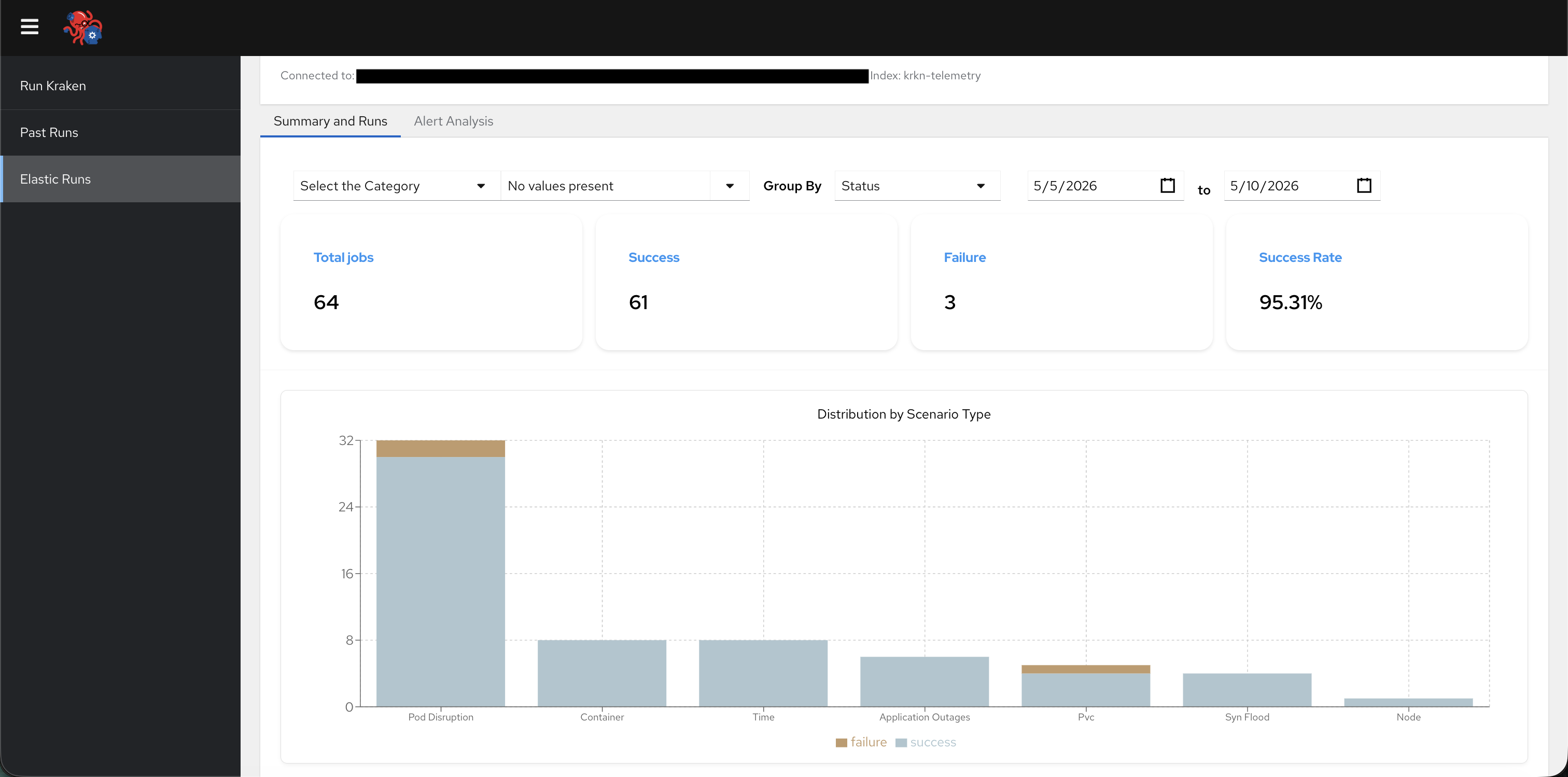
If you use Elasticsearch to store Krkn run data, open Elastic Runs and connect to your instance. After connecting, you can:
Query run details by date range and filters
View summary charts and graphs
See historical chaos runs and their metadata in the dashboard
Montitor alerts on the Alert Analysis tab
You can disconnect and reconnect to a different cluster or index when needed.
Elasticsearch configuration is optional. The dashboard will still work without Elasticsearch for running jobs and using Past Runs on the host.
Link to Grafana dashboards
When Elasticsearch is connected and you supply an optional Grafana base URL at connect time, the dashboard can link each run to its corresponding metrics and visualizations in Grafana. Grafana configuration is optional.
Users, groups, and access control
Every person signs in with their own account.
Platform admins manage users, groups, kubeconfigs, and policies in Administration
Platform users run experiments and manage kubeconfigs for their groups.
Platform roles, groups, group roles, and cluster permissions in the Krkn Dashboard.
Deprecated
krkn-dashboard is deprecated and will be archived. If you are looking for a UI to interact with krkn, please migrate to krkn-operator.
The dashboard uses platform roles, groups, group roles, and cluster policies to restrict access.
Platform roles
Role
Capabilities
Admin
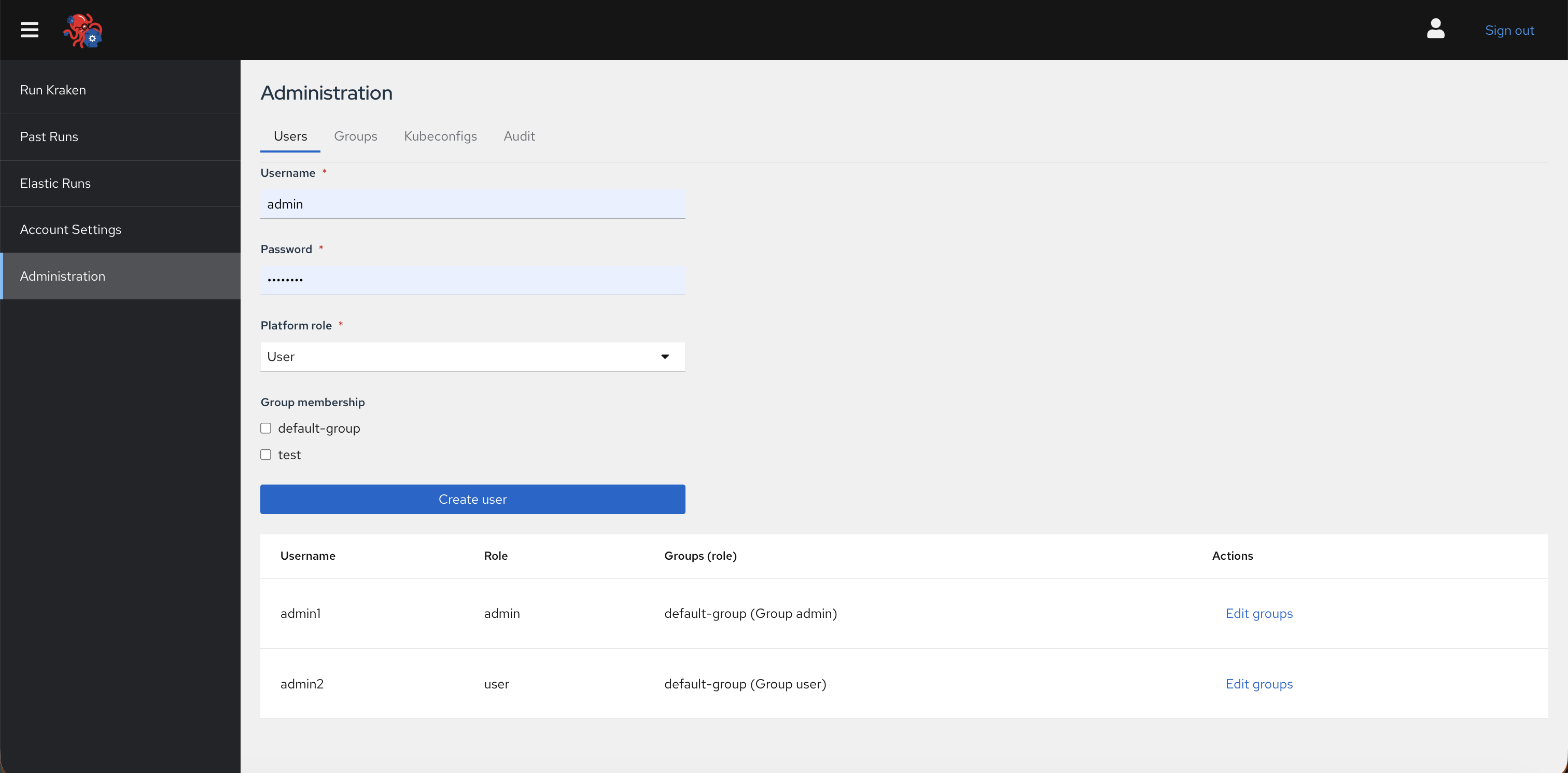
Full control: create users, manage groups and membership, view the audit trail for all users, see all runs. This is done in the Administration tab. When managing groups, kubeconfigs, and users, required fields are marked.
User
Run experiments, view past runs, manage their account, upload kubeconfigs for their groups. Users cannot create users or assign people to groups.
Platform admins also have the Administration item in the side menu. Platform users use Account Settings for their profile, password, and group kubeconfig uploads.
Groups
Teams are organized into groups. Past runs and kubeconfigs always belong to a group, not a private user list. A user only sees runs for groups he or she is part of. Replaying a run by default uses the original run’s group.
On first startup with an empty database, the server creates a default-group and places the initial platform admin in that group.
Group roles
Group role
Capabilities
Group viewer
Only observe current or past runs.
Group user
Run, view, and cancel runs on top of the viewer role’s capabilities.
Group admin
Manage that group’s policies and kubeconfigs on top of the user role’s abilities.
Important: Platform User accounts can only be a group user or group viewer, not group admin. Only platform Admin accounts may be assigned the group admin role.
Group admins manage their group from Account Settings → Manage group (policies and kubeconfigs for that group). Platform admins manage all groups, users, and kubeconfigs from Administration.
Cluster permissions
Each group has policies per cluster. A policy grants one of these permissions for a cluster key (the API server URL from the kubeconfig):
Permission
Meaning
view
See runs and data for that cluster.
run
Start chaos runs (includes view).
cancel
Cancel runs (includes run and view).
admin
Full policy management for that cluster (includes cancel, run, and view).
Policies are assigned to groups in Administration (platform admins) or on Manage group (group admins). A user must be a member of the group, have a group role that allows the action, and have a matching cluster policy for the kubeconfig’s cluster key.
Platform admins bypass group and policy checks for authorization.
Kubeconfigs
Platform admins can upload and manage kubeconfigs for any group in Administration.
Group members can upload kubeconfigs for groups they belong to under Account Settings.
Group admins can rename or delete kubeconfigs for their group on Manage group.
When you start a run, the dashboard checks that your group has the right cluster policy for the selected kubeconfig.
Audit trail
Platform admins can open the Audit tab under Administration to review actions across users (sign-ins, administration changes, and related events).
Account settings
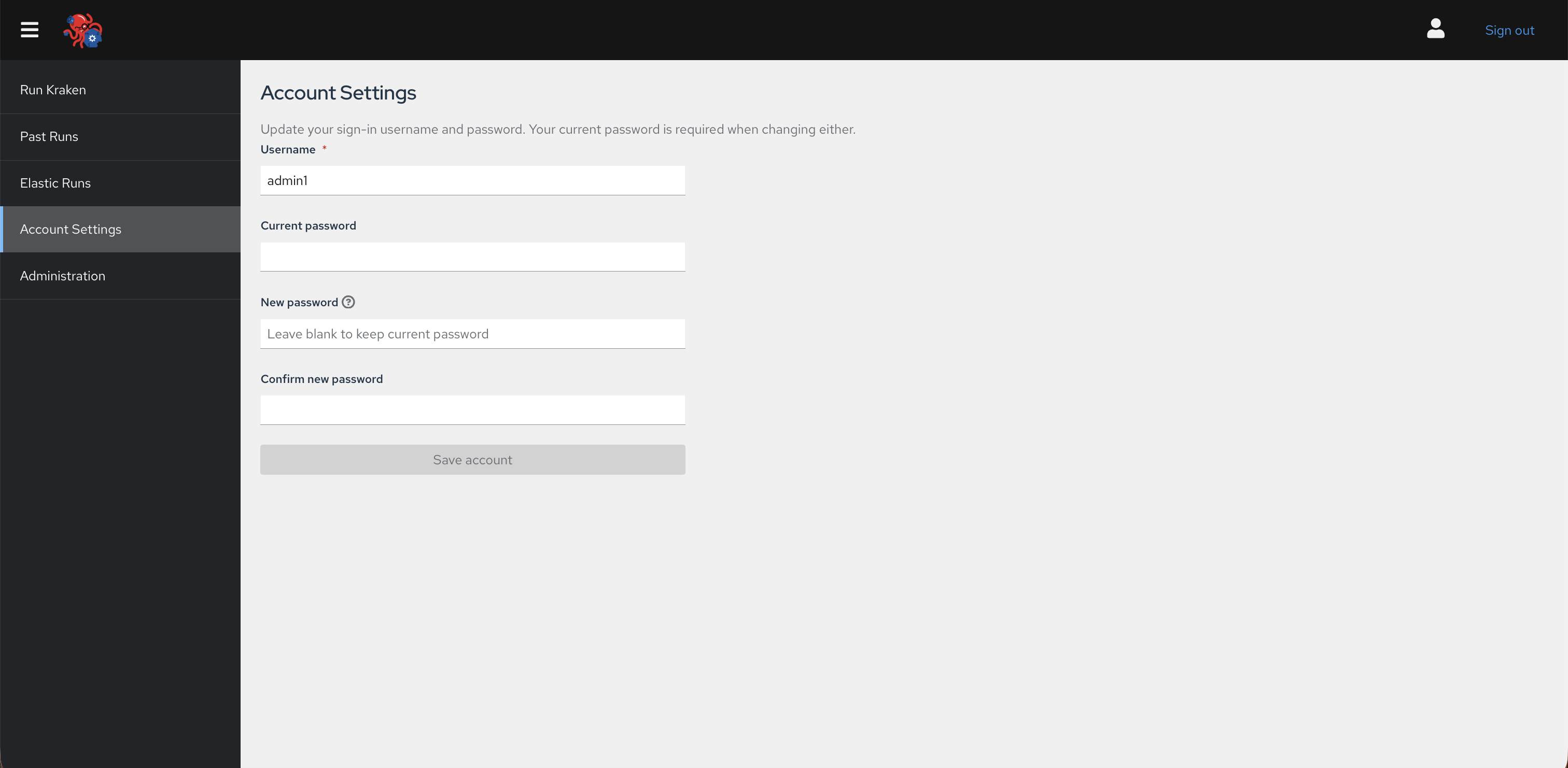
All signed-in users can open Account Settings from the side menu to:
Change their password
Upload kubeconfigs for groups they belong to
Open Manage group for groups where they are a group admin
Using the UI — Run Kraken, Past Runs, and Elastic Runs
2 - Using the UI
How to run scenarios and use the dashboard once it is running.
Deprecated
krkn-dashboard is deprecated and will be archived. If you are looking for a UI to interact with krkn, please migrate to krkn-operator.
Using the UI
When starting the dashboard, if you are not signed in, you will be sent to the login page. Use the initial admin credentials from installation on first startup, or the username and password your administrator created for you.
The side menu has five views: Run Kraken, Past Runs, Elastic Runs, Account Settings, and Administration. Each is described below.
Run Kraken
Run Kraken is the default landing page. Everything for starting a new chaos job is on this single page:
Scenarios — Scenario tiles (Pod Scenarios, Node CPU hog, Node IO hog, Node Memory hog). Click a tile to select that scenario for the next run.
Supported Parameters — Fields for the selected scenario, group selection, kubeconfig upload or choice, and Start Kraken to launch the krkn-hub container. Your account must have permission to run on that cluster for the selected group. If you arrived here by Replay, an inline notice shows the source run (the group defaults to the original run’s group).
Running Kraken containers — A table of krkn-hub containers that are currently running on the host.
Past Runs
Past Runs lists jobs recorded by the dashboard for groups you are a member of. Platform admins can see all runs.
Filters — Narrow by name, run type (all, original only, replay only), image substring, and start/end dates; use Apply filters and Refresh as needed.
Summary cards — Examine the job count, passes, failures, and pass rate.
Runs table — Sort by name or finished time. Expand or collapse rows that have replays to see nested replay entries. Select a row to open Run details and Logs. The Replay button pre-fills Run Kraken with the stored scenario parameters that were saved for that run.
Elastic Runs
Elastic Runs is for Elasticsearch and Grafana, separate from Past Runs:
Not connected — A form titled Connect to Elastic Search asks for the ES instance URL, index name, optional username and password, and optional Grafana Base URL. Submit with Connect to the instance.
Connected — The header shows the host (and index); use Disconnect to return to the connect form. Two tabs appear:
Summary and Runs — Summary metric cards when aggregations are available, charts (summary or comparison layout depending on filters), and a Runs table of documents from Elasticsearch. Expand a row to see its configuration and graphs. If a Grafana base URL was set, a link will appear to open a Grafana dashboard with a breakdown of that scenario’s data.
Alert Analysis — A table of alerts when alert data is present.
Grafana opens pre-built dashboards for individual chaos runs; those links are produced through krkn visualize. Your grafana link may look something like “http://krkn-visualize-krkn-visualize . . . openshift.com/”.
Account Settings
Account Settings is available to every signed-in user from the side menu. Platform admins use it for their own profile; platform users also use it to upload kubeconfigs for their groups.
Username and password
At the top of the page you can update your sign-in username and password:
Username — Required. Change it if you need a different sign-in name.
Current password — Required whenever you change the username or set a new password.
New password and Confirm new password — Leave blank to keep your current password. When you set a new password, it must be at least 8 characters and match the confirmation field.
Administration (platform admins)
Open Administration from the side menu to:
Users — Create users, set platform role (Admin or User), and assign group memberships with group roles. Required fields are marked.
Groups — Create groups, open a group to manage its policies and membership, or delete a group.
Kubeconfigs — Upload kubeconfigs on behalf of groups (platform-wide management).
Audit — View the audit trail for actions across users.
When creating a platform User, you can only assign group user or group viewer roles—not group admin. Platform Admin accounts may also be group admin in selected groups.